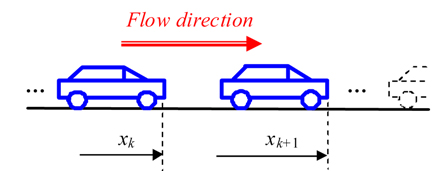
Our main objective is to investigate the dynamics of traffic flow via investigating the microscopic properties of each vehicle in traffic. We mainly focus on microscopic models since we can easily incorporate the sensing delays of human drivers.

What we mean by delay here is the amount of time it takes to make a decision (e.g. braking) upon receiving a stimulus from outside the vehicle. In this sense, there are two main sources of delays while driving

  1. Physiological states of human drivers
  2. Mechanical features of vehicles

In our approach, microscopic models are based on following one or more leader vehicles, and this suggests a way of dynamically coupling the vehicles with a unique feature that coupling exists only between the vehicles upstream (opposite direction) of the traffic flow. This is a natural consequence of following in general the vehicles ahead but not behind.

We again combine the traffic flow characterization problem with our expertise on delay differential equations, frequency sweeping techniques and stability charts. With these unique tools in hand, we investigate the following open problems:

  1. Presence of multiple delays (delay heterogeneity) due to different sensing capabilities of humans (e.g. sensing time of velocity changes is different than sensing time of position changes)
  2. Extraction of stability charts to explain the contribution of different scales of delays to traffic flow stability
  3. Utilization of stabilty charts along with string stabilty analysis to derive conditions for stable traffic flow.
  4. Investigation of how traffic flow is affected in presence of more/less aggressive drivers following each other.

We see the impacts of our research in the following areas

  1. Understanding hybrid traffic flow where human and automated vehicles travel together
  2. Designing better cruise control or decentralized vehicle cruise control for improved traffic flow
  3. Design of (semi) active driver assistance systems in order to improve driver awareness
  4. Research on inter-vehicle communication technologies.


Recently Published Relevant Work

  1. Sipahi, R., Atay, F.M., Niculescu, S.-I., 2007, Stability of Traffic Flow Behavior with Distributed Delays Modeling the Memory Effects of the Drivers, SIAM Journal on Applied Mathematics, 68(3), 738-759, available online http://link.aip.org/link/?SMM/68/738.

  2. Sipahi, R., Niculescu, S.-I., Deterministic Time-Delayed Traffic Flow Models: A Survey, Invited chapter in Complex Time-Delay Systems, to be published with Springer-Verlag, Editor: Fatihcan Atay, Max Planck Institute, Leipzig, Germany.

  3. Sipahi, R., Niculescu, S.-I., Delice, I.I., Asymptotic Stability of Constant Time Headway Driving Strategy with Multiple Driver Reaction Delays, accepted at American Control Conference, St Louis, June 2009.

  4. Sipahi, R., Niculescu, S.-I., Deterministic Time-Delayed Traffic Flow Models: A Survey, IFAC Time Delay Systems Workshop, Nantes, France, 2007.

  5. Sipahi, R., Niculescu, S.-I., Atay, F., Effects of Short-Term Memory of Drivers on Stability Interpretations of Traffic Flow Dynamics, American Control Conference, New York, 2007.

  6. Sipahi, R., S., Niculescu, S.-I., Slow Time-Varying Delay Effects - Robust Stability Characterization of Deterministic Car Following Models, IEEE International Conference on Control Applications, Munich, Germany, 2006.

  7. Sipahi, R., Niculescu, S.-I., Analytical Stability Study of a Deterministic Car Following Model under Multiple Delay Interactions, at Invited Session Traffic Dynamics under Presence of Time Delays, IFAC Time Delay Systems Workshop, L’Aquila, Italy, 2006.

  8. Sipahi, R., Niculescu, S.-I., Some Remarks on the Characterization of Delay Interactions in Deterministic Car Following Models, MTNS, Kyoto, Japan, 2006.

Recent Presentations

  1. Traffic stability problem due to delayed reactions of human drivers. Click

  2. Memory effects of human drivers to the stability of traffic flow dynamics. Click

  3. American Control Conference, 2008, Seattle. Presentation

  4. American Control Conference, 2007, New York. Presentation